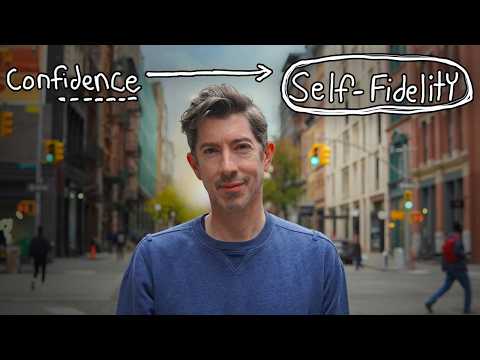
Becoming self-confident is easier than it seems (if you understand it). In this video, I discuss the insight that changed everything for me. Backed by psychological research and personal insights, I reveal the real meaning of self-confidence and how it can transform your life.
For more on psychology and personal growth, you can get my book here:
NOTE
I’m using “self-confidence” in the everyday sense, blending it with ideas like self-esteem and self-worth.
MY NEWSLETTER
CITATIONS
Bar-Shachar, Y., & Bar-Kalifa, E. (2021). Responsiveness processes and daily experiences of shared reality among romantic couples. Journal of Social and Personal Relationships, 38(9), 1–21.
Brunell, A. B., & Campbell, W. K. (2011). Narcissism and romantic relationships: Understanding the paradox. Current Directions in Psychological Science, 20(6), 335–338.
Brummelman, E., & Sedikides, C. (2020). Raising children with high self-esteem (but not narcissism). Child Development Perspectives, 14(2), 83–89.
Butler, E. A., Egloff, B., Wilhelm, F. H., Smith, N. C., Erickson, E. A., & Gross, J. J. (2003). The social consequences of expressive suppression. Emotion, 3(1), 48–67.
Czarna, A. Z., Leifeld, P., Śmieja, M., Dufner, M., & Salovey, P. (2016). Do narcissism and emotional intelligence win us friends? Modeling dynamics of peer popularity using inferential network analysis. Personality and Social Psychology Bulletin, 42(11), 1588–1599.
Harris, M. A., & Orth, U. (2019). The link between self-esteem and social relationships: A meta-analysis of longitudinal studies. Journal of Personality and Social Psychology.
Josephs, L., Warach, B., Goldin, K. L., Jonason, P. K., Gorman, B. S., Masroor, S., & Lebron, N. (2019). Be yourself: Authenticity as a long-term mating strategy. Personality and Individual Differences, 143, 118–127.
Kardas, M., Kumar, A., & Epley, N. (2024). Let it go: How exaggerating the reputational costs of revealing negative information encourages secrecy in relationships. Journal of Personality and Social Psychology, 126(6), 1052–1083.
Kernis, M. H. (2003). Toward a conceptualization of optimal self-esteem. Psychological Inquiry, 14(1), 1–26.
Kraus, M. W., & Chen, S. (2012). Relational self-verification through self-presentation: Implications for perceptions of one’s honesty and authenticity. Self and Identity, 11(4), 454–471.
Markowitz, D. M., Kouchaki, M., Gino, F., Hancock, J. T., & Boyd, R. L. (2020). Authentic first impressions relate to interpersonal, social, and entrepreneurial success. Social Psychological and Personality Science.
Orth, U., & Robins, R. W. (2022). Is high self-esteem beneficial? Revisiting a classic question. American Psychologist, 77(1), 5–17.
Sedikides, C., & Schlegel, R. J. (2024). Distilling the concept of authenticity. Nature Reviews Psychology, 3(8), 509–523.
Stinson, D. A., Cameron, J. J., & Huang, E. T. (2015). Your sociometer is telling you something: How the self-esteem system functions to resolve important interpersonal dilemmas. In V. Zeigler-Hill et al. (Eds.), Evolutionary perspectives on social psychology (pp. 137–151). Springer.
Tenney, E. R., Meikle, N. L., Hunsaker, D., Moore, D. A., & Anderson, C. (2024). Is overconfidence a social liability? The effect of verbal versus nonverbal expressions of confidence. Journal of Personality and Social Psychology, 123(4), 531–550.
von Hippel, W., Dubbs, S., Murphy, S. C., & Trivers, R. (2015). The role of overconfidence in romantic desirability and competition. Personality and Social Psychology Bulletin, 41(6), 711–723.
Wood, A. M., Linley, P. A., Maltby, J., Baliousis, M., & Joseph, S. (2008). The authentic personality: A theoretical and empirical conceptualization and the development of the authenticity scale. Journal of Counseling Psychology, 55(3), 385–399.
Zeigler-Hill, V., & Besser, A. (2011). Self-esteem and evaluations of targets with ostensibly different levels of self-worth. Self and Identity, 13(2), 146–161.
Zeigler-Hill, V., & Myers, E. M. (2011). An implicit theory of self-esteem: The consequences of perceived self-esteem for romantic desirability. Evolutionary Psychology, 9(2), 147–180.
Zeigler-Hill, V., Besser, A., Myers, E. M., Southard, A. C., & Malkin, M. L. (2013). The status-signaling property of self-esteem: The role of self-reported self-esteem and perceived self-esteem in personality judgments. Journal of Personality, 81(2), 135–148.
MY BOOK
Out now:
DISCLAIMER
This information is for educational purposes only and is not intended to be a substitute for clinical care. Please consult a health care provider for guidance specific to your case.
15 ways to become more self-confident: https://thomas-smithyman.mykajabi.com/self-confidence-insights
I love how the characters are mostly very serious and then there is skelly who’s like “Go get im!” or “yup” 🫶🏻
this video was so helpful, thank you so much. it’s great to look at this from a different perspective; rather than trying to become what you perceive as confident and perfect, becoming content and confident in the person you truly are. thanks again 🙂
For me, this boils down to: Speak when you know; ask when you’re ignorant, provide help when you can, ask for help when you need it.
Well but to do that you first need to be confident about yourself, and like all about yourself. And that is the hard part in the first place with confidence.